Transforming Your Demand Generation Engine with AI

Originally published in Fast Company

Business success depends on one variable: growth. Yet growth can feel elusive, particularly when competition within a category is fierce and new entrants are a constant threat. Enter AI (when doesn’t AI enter the conversation nowadays?). 

Many marketing leaders have visions of creating the perfect AI-powered demand generation engine that delivers a steady stream of qualified leads. And with 83% of marketers claiming content marketing is the most effective channel for demand generation, AI stands out in helping marketers identify which content resonates, leads to prioritize, or campaigns to optimize. 

The reality is more nuanced. Finding a balance between AI-generated content, brand voice and business goals is key. Consider these factors:  

PERSONALIZATION MATTERS

Millions of businesses are competing for buyer attention at any given moment across every industry. 

E-commerce retailers have perfected the art of using data to create uncannily accurate product recommendations. This personalization can be brought to life with a relevant offer like:

  • “Customer favorites”: If a product sells better than all your other products, promote it to your customers, including reviews, ratings, and testimonials from customers who purchased it.
  • “You might also consider”: Include images and links to other products that complement the one in the customer’s cart. 
  • “People also bought”: Social proof can be a powerful influencer.

When developing your personalization strategy, AI doesn’t replace the human element—it enhances it. AI scales personalization in ways that would be impossible manually, helping you meet customers where they are in their buying journey with exactly the right message. You can focus on a particular segment and personalize content with dynamic recommendations based on a customer’s digital footprint. 

MAXIMIZE DATA-BASED PERSONALIZATION 

AI-powered demand generation relies on not just any data, but clean, relevant, and actionable data that provides insights into an individual’s customer behavior, preferences, and needs. 

AI excels at analyzing vast amounts of customer data, identifying patterns and predicting needs before customers articulate them. This predictive capability allows marketers to anticipate what content will resonate with specific segments and deliver it proactively. 

For example, AI can analyze a prospect’s engagement with your website, identifying which pages they visit, how long they stay, and what content they download. It can then trigger relevant content addressing their specific interests, creating a personalized, almost intuitive experience.

Integrate marketing automations into your processes to create personalized, data-driven emails at scale. By using pre-built customer journeys, you can convert more customers at key moments—and at scale.

USE AI TO ANALYZE LEAD SCORING AND NURTURE PROCESSES 

Traditional lead scoring models often rely on arbitrary point systems that may not accurately reflect a lead’s actual buying intent. AI transforms this process by continuously analyzing behavior patterns that correlate with successful conversions. 

Machine learning algorithms identify which actions or combinations of actions most reliably predict purchase intent so marketers can prioritize leads more effectively. This dynamic approach to lead scoring ensures sales teams focus on prospects most likely to convert. 

Beyond scoring, AI also revolutionizes the nurture process. Rather than pushing leads through a predetermined, linear nurture flow, AI-powered systems create dynamic journeys that adapt based on individual engagement and behavior.

So, customers who discover your brand through a social media ad can be served different content than those who organically find it through a Google search. AI can produce content that speaks to the customer’s journey rather than applying a one-size-fits-all approach. 

These intelligent nurture paths can determine the optimal cadence, channel, and content for each lead by increasing engagement rates and shortening sales cycles

TRANSFORM BRAND DEVELOPMENT 

Even with all this automation, brand voice and positioning remain critical to demand generation. And yes, there are different AI tools for that.  

StoryBrand.ai, for example, helps businesses position their customers as the hero and their brand as the guide, creating messaging frameworks that tap into the power of storytelling (full disclosure: StoryBrand.ai is a Thryv partner). Such tools provide language that emotionally connects with audiences while maintaining consistency across touchpoints. 

By using AI-powered brand development tools, you can ensure that even as personalization increases, your core brand messaging remains cohesive. 

REVIVE CAMPAIGN AD DEVELOPMENT 

Creating compelling ad content at scale has traditionally been a resource-intense process. AI changes this by generating and testing multiple variations of ad copy, images, and calls to action. 

AI tools can produce dozens of ad variations based on core messaging, so marketers can test different approaches without creative bottlenecks. These systems learn from performance data, continuously refining creative elements to improve conversion rates. 

For example, Klarna, a global online shopping company, used AI to generate and test 1,000+ ad image variations over three months—an impossible feat with traditional creative processes. This reduced the amount of time spent checking images for brand consistency, image quality, and legal compliance—seven days compared to six weeks—saving $6 million in image production costs.  

While AI excels at optimization, human creativity remains essential for developing breakthrough concepts and emotional connections. For a successful approach, combine AI’s analytical capabilities with human creative direction.

USHER IN REAL-TIME CAMPAIGN OPTIMIZATION 

Perhaps the most powerful AI application in demand generation is real-time campaign optimization. Traditional campaigns can require weeks of data collection before meaningful adjustments can be made. AI-powered systems identify performance trends much earlier and make automated adjustments to improve results. 

These systems reallocate budgets across channels, adjust bidding strategies, modify targeting parameters, and even adapt creative elements—all in real time and based on performance data. This agility can allow you to maximize ROI by doubling down on what’s working and quickly moving away from what isn’t. 

A WINNING COMBINATION 

Successful demand generation has always been about connecting with potential customers in meaningful ways. AI doesn’t change this fundamental truth—it provides the tools to do it at scale with greater precision and effectiveness. 

Taking your brand’s authenticity and human understanding and blending it with the analytical power of AI creates a demand generation engine that doesn’t just produce more leads—it produces better leads that convert at higher rates. Ultimately, that’s the true measure of demand generation success and the foundation of business growth.

Did social media save Nayati Moodliar?

Last week, a friend who lives in Kuala Lampur posted a disturbing facebook entry. Her neighbor, Nayati Moodliar, a small boy of 12, was pulled into a car by two men on his walk to school. The kidnapping spurred an international social media campaign and mobilized the community. Instead of going to work or school, families living in the community spent 24/7 shifts manning phones and spreading word of the incident through social media. Nayati’s parents used Facebook to post pictures with a plea to send a ‘virtual hug’ that Nayati would be found. His father went to Twitter to say, “To the captors, you may be captors too. So I pray for your release. That U may find the compassion to set Nayati free”. Nayati’s schoolmates placed videos on YouTube, appealing for his safe return and urging the public to spread the word via their social networks.

Amazingly, after six tense days and a viral social media campaign to help find him, Nayati was found unharmed. His overjoyed father was quoted as saying, “This entire week has not only been a story of Nayati’s kidnap. It has been a story of compassion, courage and love which highlighted the goodness inherent in everyone”.

Indeed the story of Nayati Moodliar’s kidnapping was not only that of his disappearance – but also of how his family and community used social media to mobilize international support to find him.  It also raises a more profound question. Does Nayati’s return prove there is a greater good in the world that can be harnessed? Can collective intention influence the physical world? I don’t know the answer but I do know that I gave that virtual hug and it felt good to know that Nayati had returned home.  Furthermore, this family gets my vote for launching the most successful social campaign of 2012!

Welcome home Nayati.

.

5 steps to a digital microsite that converts

Microsites can be a powerful lead generation machine any time you have a unique call to action especially when 50% of purchases start online these days.  To be effective, a digital campaign must drive a relevant conversation. David Meerman Scott nailed it when he said,  “Instead of one-way interruption, web marketing is about delivering useful content at just the precise moment that a buyer needs it.” Finding the right conversation and capturing that interest in a digital microsite is the holy grail of digital demand generation.

Here are my top 5 quick tips on how to drive a successful lead generating microsite that will support a successful digital campaign.

1. Start with the market conversation. Let’s say you are building a site for marketers, your first step would be to start with research on organic momentum for marketing topics. Take the time to think about what marketers care about now — Social Media Marketing, Mobile Marketing, Behavioral Marketing, etc.

2. Build a microsite that is experiential.  Your microsite should be an immersive experience.  Its goal is to provide the visitor with lots of rich information in a very interactive, compelling manner, with a rich use of multi-media assets.

3. Consider serving dynamic content. You may want to consider a different experience based on the prospect’s interest and buying stage. If a user downloads a white paper on an overview on ad retargeting, you can assume they’re in an exploratory stage; your website can be configured to serve up more content aligned with that stage.

4. Include relevant tie-ins to social media. Do you have a Twitter following, Facebook fan page or LinkedIn community? Make sure to add the appropriate share icons to show viral growth.  Pen blogs & consider media placements to drive relevant audiences to your site.

5. Use analytics.  The use of social media analytics, web analytics and behavioral analytics will help you get to know your prospects & push relevant information. For example, find out what audience your microsite is targeting through web analytics that let you do SEO and inbound traffic analysis to show how many people clicked from non-email links. Media analytics can also show how many ads were clicked that then led to conversion.

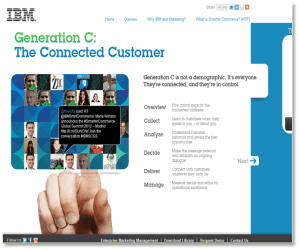
Here is an example of a microsite we just launched in the U.S. projected to drive 15,000 registrations  for our organization.  What do you think?

http://www.ibmconnectedcustomer.com/us

How does Justin Timberlake know what’s cool?

I thought I had heard it all, that is, until I discovered this session on ‘Coolhunting’ during my time at SXSW. Let’s just say, I wish this science was something they taught in high school. It sure seems to beat out chemistry, and I am almost positive it would have gotten me a ticket into the cool crowd instead of the science geeks.

So, what exactly is this latest science? Coolhunting is the art of combining data mining with social interaction heat maps to find ‘cool’ trends. Apparently even celebrities, like Justin Timberlake, have discovered this ‘science of cool’ and are using it to their advantage. In fact, Justin even hired a team of scientists to help him capitalize on trends and raise his ‘coolness’ profile.

This same methodology can also be used to find trendsetters. In the hunt for influencers, it’s important to note that 1 or 2 people are always the ‘nodes’, aka ‘new trendsetters’, that kickoff a viral trend — Everyone else is an additive. So, how do you find these trendsetters? Peter Gloor, from the MIT Center for Collective Intelligence, is working to make a science out of it. According to Peter, collective intelligence is becoming more and more apparent in the universe. By mining this intelligence and combining it with social media, we can find influencers, and in turn, find trends early in the cycle.

In a world where 90% of all data  has been generated in the last 2 years and continues to accelerate, data mining is a science that is paying off in huge dividends.  Businesses that can manage to leverage social analytics and data mining will clearly have a higher competitive advantage. They will become the cool new ‘nodes’ for trends.

You have to admit… pretty cool!

5 Things I Learned at SXSW

I spent the weekend at the South by Southwest (SXSW) festival in pursuit of innovative marketing and social media ideas. After attending a weekend of sessions, I decided the best marketing lesson of all was this phenomenon called SXSW, which has developed a cult following of sorts. So here follows 5 lessons I learned from SXSW:

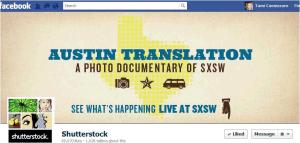
1. Great use of brand page. We’ve all done them —  the lame brand page that begs softly “Please like me”. SXSW amped up usage of its brand page by employing a band of mobile Fotogs to catch the energy of the conference in a ‘photo documentary’ Facebook fan page. Shutterstock also invited attendees to tweet their photos to @Shutterstock using the hashtag #SXSWpix. The documentary was projected on a six-story wall projection. Add a liberal dose of free ‘beverages’ and call it fun, great social media marketing.


 2. An all-in-one mobile app. In addition to session content, The SXSWGo app included networking info on registered attendees, which let you make connections with other attendees. Pixable pulled images into the app from Twitter and Instragram photos that carried the #SXSW hashtag. The app was used widely by attendees for both session content & networking. Very cool mobile marketing approach.

3. Videos to tell the story. Liberal use of video aggregated on a compelling You Tube channel. More and more, this generation has forgotten how to read (irony not lost on me). The videos had great energy & gave user testimonial to a great festival.

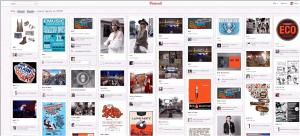
4. Cinematography via Pinterest. The SXSW board showcases bands performing, SXSW music parties & SXSW Interactive speakers and events. It added a visual component to the site’s coverage, helping to capture the festival’s spirit.

 5. Social connections through Twitter: Hashtags on every unique session helped attendees to build communities of people of like interest.  Big boards around the conference featured tweets. (Interestingly, the tipping point for Twitter’s popularity was the 2007 SXSW festival. During the event that year, Twitter usage increased from 20,000 tweets per day to 60,000).

All in all, the conference had a great buzz. Social mirrored the real life interaction minus the seemingly endless stream of happy hours. Well done SXSW.

What ever happened to Jet Blue?

I remember a day when I had a warm, fuzzy feeling as I booked a flight on my favorite carrier— Jet Blue. I loved the nice, simple Jet Blue web site design and branding, their warm, welcoming, young staff, the big TVs and the roomy seats on the plane. It all said fun, cool and friendly. I made Jet Blue my first choice to fly as a rule. A great option to an otherwise poor playing field of carriers.

Fast forward to my trip last night. Long three hour lines; an angry, seemingly eternally angry, unapologetic staff; check-in kiosques that were broken (and clearly not getting any attention) were among the worst offenses. Once we boarded, the airline experience was pretty much indistinguishable from any other except for the $6 pillow and blanket charge on a very cold flight. What ever happened to the ”Jet Blue” experience that I remembered?

Long story short, my alliance to Jet Blue as an erstwhile lifetime fan dissipated with one bad trip, one bad day. It would seem Jet Blue’s customer differentiation is a bygone of better days. At a time when customers are at a premium and tend to be vocal about good/bad experiences, I am not optimistic the airline has adopted a winning strategy. Every interaction with a customer is a chance to win or lose loyalty, to make a positive or negative impression. I’m sure I wasn’t alone last night. But I for one won’t be coming back any time soon. I look back on my days of flying with Jet Blue as a jilted lover, disappointed that love didn’t last….

5 ways to be found in the web jungle

Interview with Frank Donatone, co-author of ‘Audience, Relevance and Search’


Frank, you’ve been working to drive natural search rankings on IBM.com for key terms. Can you talk about your overall strategy & some of the tips you give to webmasters when building out their web presence?

The key to SEO is capturing prospects in all phases of the sales cycle — essentially it’s all about getting the right content at the right time to the right audience.  You need to focus on freshness, relevance and engagement of your audience. I have a few general rules that are critical to a winning strategy:

1.   Do the proper keyword research. Find the epicenter of organic interest. The first thing to do if you want to optimize your pages for search is to find out what keywords, related to your theme or topic, are searched for most often by your audience. These keywords become your site’s nomenclature. If you place these words and semantically related terms prominently on pages in your site, you will have a better chance to get higher ranking pages in search engines and qualified traffic.  

2.   Use relevant content to capture prospects in the awareness phase. Your web landing page experience needs to tap into the interest of the searcher using keywords that are relevant to that searcher. Think of it like searching for a mate on ‘match.com’; the more you have in common, the more likely you will get asked for a first date. Remember traffic volume is not the end game — the end game is targeted qualified traffic.

3.   Focus on long-tail search more specific to your product. The idea is to develop a set of 3-4 related keywords, or a “keyword cloud”, which are searched by your target audience frequently. Then you need to develop pages that use the words in this cloud. For example, use “supply chain for retail” instead of “supply chain”. Sure, you will get less traffic, however the traffic you get will be targeted and create a lower bounce rate, therefore, better results for your search marketing efforts.

4.   Maximize your “findability” on social media sites.  Social media is critical for success since social sites have their own internal search engines and are also ranking factors and integrated into the results of external search engines like Google and Bing. Take Google for instance, it has integrated its new Google+ social network and its +1’s feature within Google search results, creating ways to be found through social media and influencing search ranking position. When you use keywords in social profiles, Tweets and Facebook updates, you are making yourself “findable”. Images and video content are also becoming increasingly important factors to be relevant in social media and external search engines.

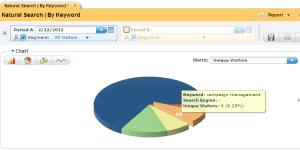
5.   Continuously measure web effectiveness. First, you need to look at page ranking; second, the volume of visitors you get from Google and other external search engines. Web analytics tools, such as IBM Coremetrics Web Analytics, can help you find out where your visitors are coming from and then filter the results to show only those who come from external search engines. You can also run reports in modern web analytics tools that show what keywords brought users to your pages, and in what volume. You can also measure performance by looking at metrics like visits, bounce rate, time on page and conversions.

Thanks Frank. This is great advice for Marketers. I’ll try to think of SEO as a dating game — make yourself attractive to those prospects and engage in their social circles to find your match!

I’m in love…

I often find myself wondering, what is it that drives brand loyalty? I have a theory that falling in love with a brand is only two steps removed from actually falling in love. I came to this realization not just because Valentine’s Day is around the corner, but because I’m currently having a torrid love affair with several brands: Apple, Gilt Groupe, Michael Kors, among my top 3.

So, what is it about these lurid brands that has attracted me? As a society we’ve become so brand focused, it’s second nature. Where does Apple leave off and I step in?  At some point I lost track of the boundaries, and somewhere here within lies the magic!  There appeal is an allure I can’t resist — I’m in Love.

The innovation that is Apple. The classic style that is Michael Kors. The decadence that is Gilt Groupe.


Each of these admired brands has unlocked a secret ingredient. It would seem to me they have managed to exude brand at every touch point, every interaction… whether in store, on the web, or over mobile… in their packaging, in the store, and certainly in their advertising. Creating this ‘persona’ of a brand is an almost impossible task for today’s corporations, but one well worth the effort to build fans and loyal customers who will fall in love with (and hopefully remain faithful to)  your brand. 

Are you my friend?

I spent the day at the #SocialCommerce Summit in New York City today. It was a packed agenda filled with ruminations and theory on the intersection of Social Media and Commerce. The discussion has me pondering the enormity of the social phenomenon which is touted as just as revolutionary as the emergence of the web a decade ago. Interestingly, it occurred to me, that the broader story isn’t about technology at all but about the basic human need for human connection.

I learned today that the oneset of Facebook has changed the rule from 6 degrees of separation to a norm of now 4.9 degrees of separation. That’s why we,  as marketers,  have moved from mass advertising to micro-location based targeting within communities of users. This social shift has changed the very dynamics of commerce. We are now living in a liquid economy where 100s of users can be a relevant, targeted customer base. Hence the rise of location- based, community-based social communities all geared to making relevant human connections.

For today’s consumer, the WHY matters as much as the WHAT. For example, if I have tickets to a concert, I can sell to the highest bidder on Craigslist, but I would rather sell to a friend. There is more being exchanged than money in this transaction. In today’s economy, you need to think about the full economics of the transaction beyond the dollar value. To today’s digital buyer, the connection matters more than the end service or product and therein lies the secret to these new business models.

In fact, the contextual relevance matters so much that communities are developing story-based engagement models. I want to engage, learn, buy from others I trust in my circle. A story is formed around me and those who ‘like’ me. They matter to me more than commerce, more than material ‘things’.

Do I want to go to that ‘Kings of Leon’ concert? Buy that new ‘Chloe’ bag? Drink your brand of ‘Starbucks’ coffee? It depends:  are you my Friend?

A second chance to make a first impression

It’s remarkable what you can do with technology in the area of digital targeting these days. After recently completing a pilot on ibm.com, retargeting proved to be a cost-effective solution that generated impressive results in click through, conversion, and sales rates. Amazingly, when comparing ad-retargeting sites to a control group, they were 5x more effective.

Over the course of the entire campaign, performance averages were $7 per conversion for retargeting vs. $710 per conversion for standard run-of-site banner advertising — Pretty impressive in my book.

For those of you not aware, retargeting is the practice of using targeted display ads and personalized emails to re-engage visitors who left your web site without purchase or conversion. These ads will essentially ‘follow you’ across your favorite web sites, intending to remind you of the interest you originally had in the site or shopping cart that was abandoned.

A secondary benefit of the ad-retargeting pilot was gaining the knowledge of where my target audience is on web and how they use it. I sat fascinated as I learned my prospects tend to read trade magazines like e-commerce weekly and Business network news, they live in Seattle & NY and are more likely to respond to an offer on Friday afternoons. Now, I can use these details to boost my next media buy or campaign or event…

As competition for a finite universe of shoppers intensifies, retargeting has emerged as an indispensable tool in a marketer’s online kit. I feel better about no longer sitting back with my fingers crossed, hoping my prospects will return. Not to mention that getting to know my customer more closely is a fantastic secondary benefit. Now how cool is that?